
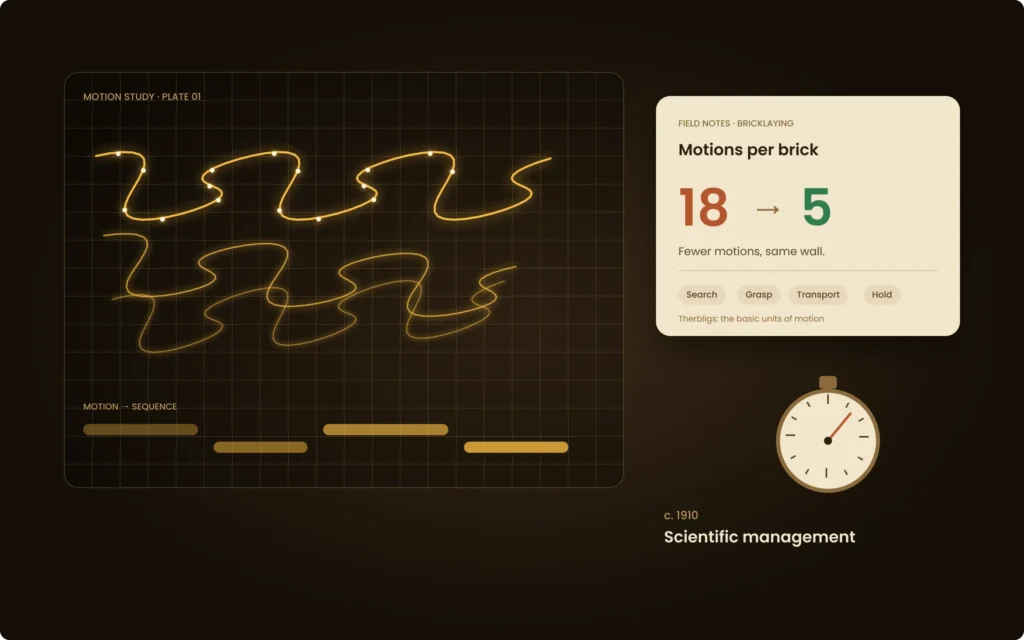
Open almost any construction productivity course and you’ll find the same story. In the early 1900s, a contractor named Frank Gilbreth watched his bricklayers work and counted about eighteen separate movements to lay one brick. He redesigned the scaffold and the material layout around them and cut that to four or five.
It’s a real result, and it’s usually told as one man’s insight from a building site. Both halves of that deserve a closer look. The building site is the part most histories skip: Gilbreth’s ideas about measuring work were formed running construction jobs, long before they reached factories. The one man is the part most histories get wrong: for most of the research that made the Gilbreth name matter, there were two people behind it.
Before Motion Study, Gilbreth Was a Contractor
Frank Gilbreth started as a bricklayer’s apprentice and worked his way up to superintendent. In 1895, at 27, he started his own contracting firm. It built dams, canals, factory buildings and an entire town in Woodland, Maine, and it won work on speed.
That speed came from method, not just effort. Gilbreth patented equipment for a trade moving from brick to concrete, including an adjustable scaffold that kept bricklayers level with the wall, and a concrete mixer. He coordinated work across his sites and wrote down how each job should run.
His first book, Field System (1908), was the result: a manual for how a construction site should be organized and run day to day. Concrete System followed the same year. Both were written for contractors, not factory managers.
The Bricklaying Study: Measure the Work Before You Schedule It
The bricklaying study came from the same instinct. Gilbreth noticed that his bricklayers each did the same job differently, and that most of their movements added nothing. He raised the scaffold so they stopped stooping, and arranged bricks and mortar so the next one was always within easy reach. Movements per brick fell from about eighteen to four or five. He published the method in Bricklaying System (1909).
The lesson for planners and schedulers isn’t the number. It’s the order of operations: study how the work is actually done, establish realistic crew productivity, and only then build the schedule. Every production rate in a CPM schedule, and every activity duration calculated from a quantity and a rate, descends from that question.
Why Speed Alone Wasn’t the Answer
In December 1907, Gilbreth met Frederick Taylor and joined the scientific management movement. The alliance didn’t last. Taylor’s tool was the stopwatch: time each task and push for the fastest version. The Gilbreths asked a different question: whether a motion was needed at all, and what it cost the person making it.
The difference mattered outside the textbooks. In 1911, machinists at the Watertown Arsenal walked out when a Taylor associate began timing them with a stopwatch. Congressional hearings followed, and by 1915 stopwatch time study was banned in government arsenals. Workers hadn’t rejected efficiency. They had rejected a pace set with no regard for what it cost them.
By 1914 the Gilbreths had broken with Taylor. Their answer to Watertown came largely from the second half of the partnership.
Lillian Gilbreth and the Cost to the Worker
Lillian Moller met Frank in 1903, married him in 1904, and became his full working partner. He called her “Boss.” Where Frank measured motions, Lillian studied what they did to people: fatigue, monotony, morale, the strain of repeating one movement all day.
Her 1914 book, The Psychology of Management, argued that efficiency that ignored the worker’s wellbeing wasn’t efficiency at all. It’s a founding text of organizational psychology and ergonomics. The publisher printed it under “L. M. Gilbreth,” doubting readers would trust a management book by a woman. A year later she completed her doctorate in applied psychology at Brown.
The method that grew out of the bricklaying study needed both of them. Frank’s measurement showed which motions the work actually required. Lillian’s psychology showed what each one cost the person making it. A faster motion nobody can sustain isn’t an improvement, and a theory of wellbeing with no way to measure it changes nothing on site.
On a construction site the same rule holds. A production rate that assumes a crew at full pace all day, every day, isn’t a rate anyone will hit.
The Name on the Door
Frank died of a heart attack in 1924, at 55. Several clients cancelled their contracts when they learned his widow would run the firm. The work hadn’t changed; their assumption about who could do it had.
Lillian kept the consultancy running, kept publishing, and raised the couple’s twelve children, a story two of them later told in Cheaper by the Dozen. The book made the family famous, but it fixed Frank’s image in popular memory, not Lillian’s professional record.
That record kept growing. She applied motion study to kitchens, hospitals, and tools for disabled workers and returning veterans. In 1935 she became Purdue’s first female professor of engineering, and she was later elected to the National Academy of Engineering and awarded the Hoover Medal.
She didn’t lose credit to someone else. The work never had a name that could hold both of them, and the industry defaulted to the one it already knew.
What Motion Study Still Teaches Construction Planners
Strip away the history and the Gilbreths left one test every construction schedule still has to pass: is the plan built on work as it’s actually done, by crews who can sustain it?
An activity duration built on a production rate no crew can hold isn’t a plan; it’s a schedule delay waiting to happen. That’s why the judgment in a schedule matters more than the hours spent assembling it: what a crew can really produce, where work can overlap, which logic drives the critical path, what the site will allow. Yet most of a planner’s week still goes on assembling: building the WBS, sequencing activities, loading resources, and updating the schedule in Primavera P6 every time the project moves.
That’s the problem ConstructMind is built for. As an AI-powered project controls platform, it turns your project information into a working schedule and keeps that schedule current, so planners spend their time on decisions instead of rebuilding the plan. It generates the schedule; you approve it.
FAQ
Was Frank Gilbreth a construction contractor?
Yes. He started his own contracting firm in 1895 and built dams, canals, factories and an entire town before he moved into management consulting.
What is Field System?
Field System (1908) was Frank Gilbreth’s first book: a manual for how a construction site should be organized and run day to day.
What did Gilbreth’s bricklaying study find?
By redesigning the scaffold and the material layout, Gilbreth cut the movements needed to lay one brick from about eighteen to four or five.
How was Gilbreth motion study different from Taylor’s time study?
Taylor timed tasks to find the fastest pace. The Gilbreths asked whether each motion was necessary at all, and what it cost the worker.
What did Lillian Gilbreth contribute to motion study?
The psychology: fatigue, monotony and morale. Her 1914 book, The Psychology of Management, argued that worker wellbeing is part of efficiency, not opposed to it.
How does motion study relate to construction scheduling?
Activity durations in a CPM schedule come from quantities divided by production rates. Motion study established that those rates should come from how the work is actually done and what a crew can sustain, not from ideal output.
Is time and motion study still used in construction?
Yes, under names like work study, productivity studies and lean construction, which treats unnecessary motion as one of its wastes. Planners use the results as production rates when they estimate activity durations.
