
Your schedule has a quality score. Now you can see it.
ConstructMind audits any Primavera P6 schedule against the standards that governance teams, clients, and independent reviewers actually use. You see your score, your findings, and exactly what to fix before anyone else does.
What project are you planning?
Briefly describe your project to generate a tailored schedule.
Most schedules get submitted. Few get properly reviewed.
A 5,000-activity P6 schedule takes days to review properly logic density, float distribution, critical path integrity, constraint usage, baseline alignment. Most review processes are a time-boxed pass at best.
So issues get through. Not because anyone was careless. Because the tools for proper schedule QA haven't kept up with the complexity of modern programmes.
On NEC contracts, an accepted programme becomes a contract document. It sets the baseline against which delays are measured, float is calculated, and extension of time entitlement is assessed. On FIDIC projects, the schedule is the primary evidence for Clause 8.5 extension of time claims. Submitting a schedule with undetected quality issues is not just a professional risk. It can limit your contractual options at the worst possible time.
The first time many planners see their quality score is in a review meeting when someone else has already found the problems.
What ConstructMind
checks and why it matters

Logic integrity
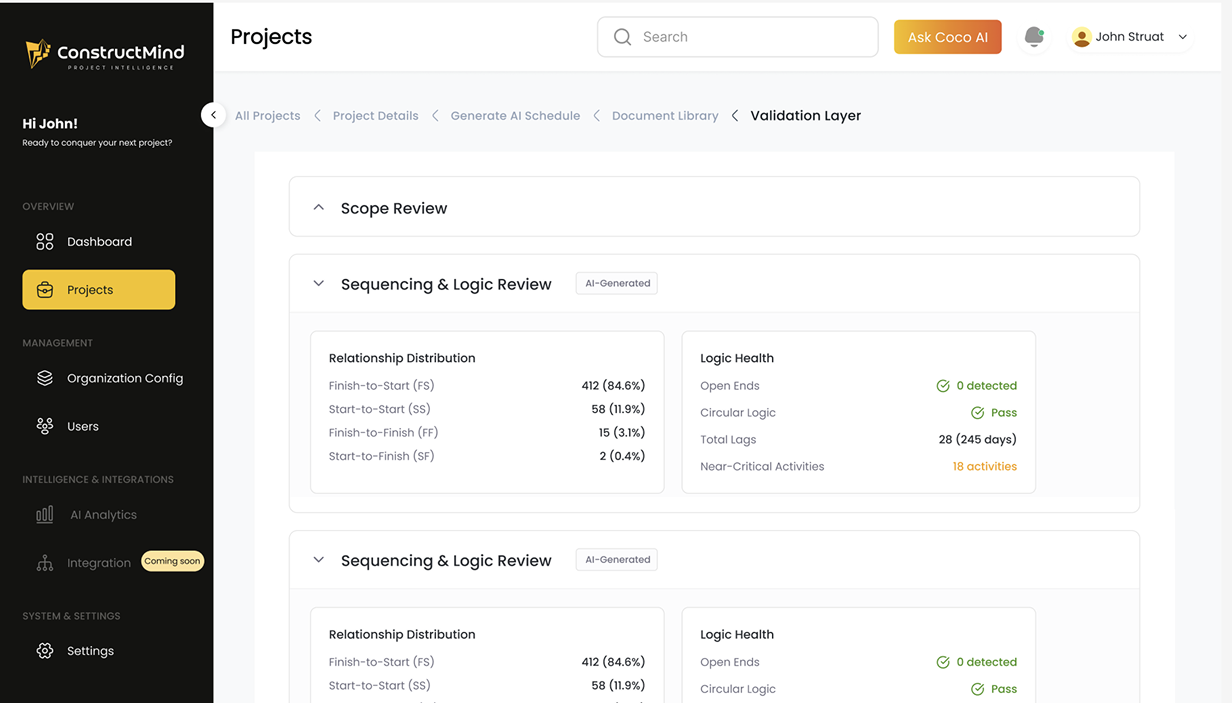
Open ends, missing predecessors, excessive lags, and logic loops the issues that make a schedule mathematically sound but practically useless. Flagged with activity-level detail.
Standards basis: DCMA 14-Point Assessment criteria for open ends, logic density, and lag usage.

Float distribution
Total float, free float, and negative float across the network with alerts for float hoarding, artificial constraints masking real risk, and negative float that isn't being managed.
Standards basis: AACE International RP 49R-06 and NEC contract float ownership principles.

Critical path integrity
Is the critical path driving the end date or is it an artefact of constraint dates? ConstructMind identifies true critical paths and flags where constraint-driven logic is hiding schedule risk.
Standards basis: AACE International RP 14R-90 CPM scheduling standard. Identifies true CPM-driven paths vs constraint-driven artefacts.

Calendar and resource alignment
Activities running on mismatched calendars, resource over-allocations, and shift patterns that don't reflect site reality. Caught before they drive a misleading forecast.
Standards basis: BS 6079 and ISO 21502 calendar convention requirements.

Baseline deviation
How far has the schedule drifted from baseline? Which activities have slipped, which milestones are at risk, and where is the critical path now compared to when it was agreed?
Standards basis: AACE International RP 52R-06 schedule update and maintenance requirements.

WBS and coding completeness
Missing activity codes, incomplete WBS coverage, and non-standard naming conventions the quiet issues that prevent meaningful reporting and make portfolio analysis impossible.
Standards basis: PMI Practice Standard for Work Breakdown Structures and client-specific coding conventions.

Milestone and contract alignment
Are your contract milestones still achievable based on the current network? Are key handover dates logically linked to the activities that drive them or are they floating?
Standards basis: NEC Clause 31.2 programme requirements and FIDIC Sub-Clause 8.3 programme submission obligations.
What you receive after a validation run

Quality Score
A single score calibrated to construction scheduling best practice that tells you where your schedule stands. Tracked across versions so you can see improvement over time.
Scores are calibrated against DCMA 14-Point Assessment criteria and weighted by finding severity. A score of 85 or above is typically required for NEC programme acceptance and formal client submission. First-pass scores on new schedules commonly range from 65 to 75. With Coco's guidance, most teams reach 90 or above before baseline.

Revised XER Export
Once you've addressed findings with Coco's guidance, export an updated XER with an appended validation summary. Your client gets the schedule and the evidence that it's been properly reviewed.
The exported XER includes an appended validation summary: a structured record of what was checked, what was found, and what was resolved. Suitable for contract correspondence, NEC programme acceptance records, and programme governance audit trails.

Recommended Actions
For each finding, Coco explains why it matters and suggests a specific fix. You decide which ones to address Coco tracks the impact on your quality score as you work through them.

Structured Findings Report
A prioritised list of issues, grouped by category (logic, float, calendar, baseline, etc.), with activity-level detail for every finding. No vague recommendations specific actions.
For anyone who needs to know their schedule is sound
Principal Planner
Run your own validation before submission.
Find the issues yourself and fix them before a reviewer or a client does.

Programme Governance / PMO
Apply the same validation standard across every project in your portfolio. Consistent quality thresholds. Comparable scores. Audit trail on every submission.

Project Manager
You're accountable for the programme. ConstructMind gives you an independent quality view so you're not relying solely on the planner's sign-off.

Independent Reviewer / Owner's Team
Review contractor schedules faster, with more rigour, and with a documented findings record that holds up when disputes arise.

See what score your current schedule would get.
Book a demo — bring a schedule. We'll run it through live.
Unlock the potential of Construction AI
Fill out the form below

Project intelligence for the built world.
An AI first project controls platform. Implementation and customer success delivered through our system integration partners.
ConstructMind AI outputs are generated using artificial intelligence and are designed to assist, not replace, the judgment of qualified planning professionals. All schedules, estimates, and assessments produced by the platform should be reviewed and validated by a competent person before use in a contractual or commercial context.
Primavera P6 is a registered trademark of Oracle Corporation. Microsoft Project is a registered trademark of Microsoft Corporation. ConstructMind AI is not affiliated with, endorsed by, or sponsored by Oracle or Microsoft. DCMA and GAO schedule assessment methodologies are referenced for informational purposes only.

SOC 2 Type II Certification

ISO 27001 Certified
© 2026 Constructmind Inc. All rights reserved. Privacy Policy